
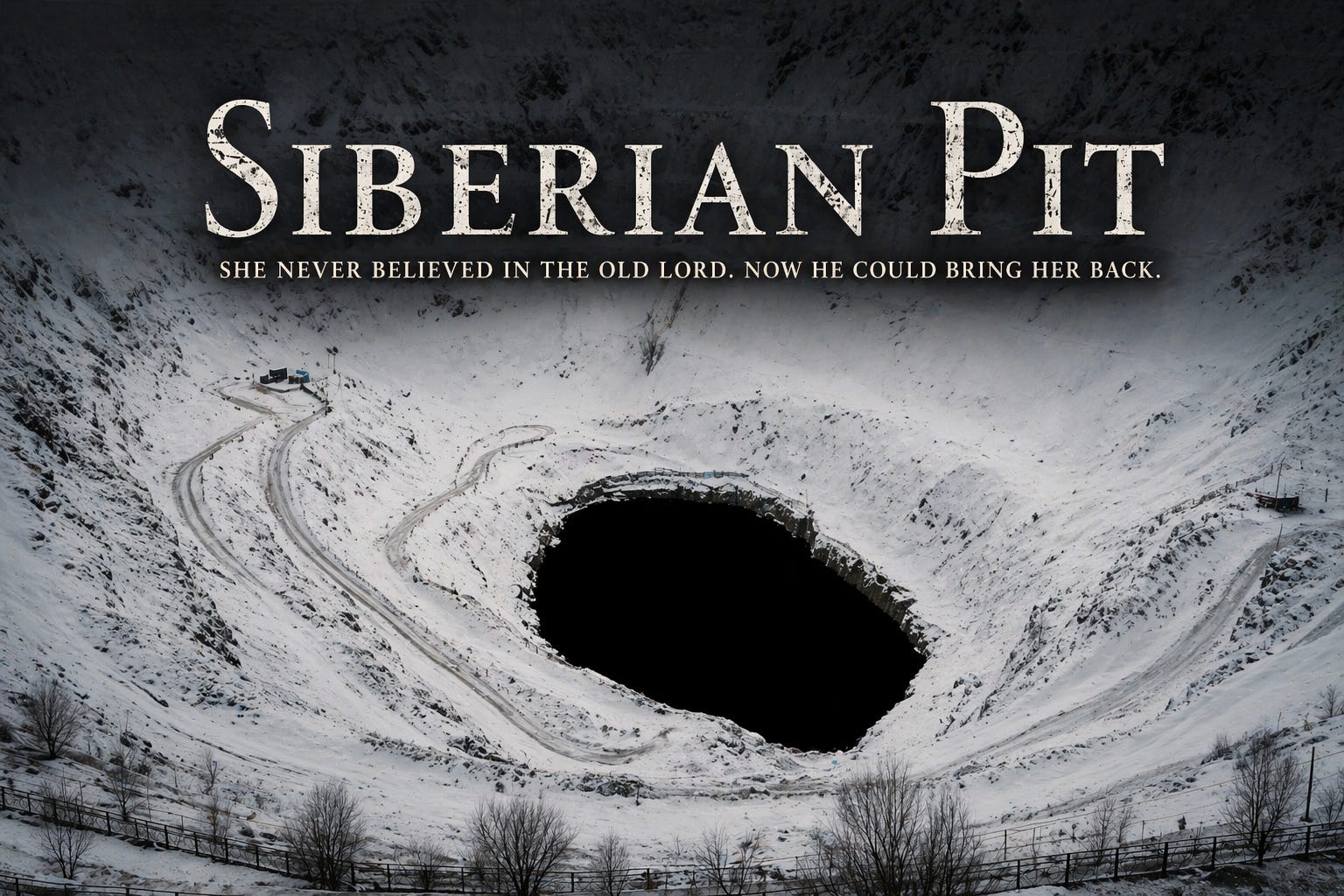
The Siberian Pit
She never believed in the old lord. Now he could bring her back.

“The old lords do not heal for free.”—The millennial scrolls, volume 12
Brian couldn’t see his own hands. He only knew he was heading in the right direction by the rising elevation. Snow fell in sheets. The infuriated wind picked up ice crystals and hurled them at Brian’s body. Even through his layered clothing, the abrasive edges poked into his skin.
He gripped a rope so tightly that his knuckles were as white as snow under his gloves. The rope dragged behind him, attached to a long sled. At the front was a stack of supplies, crates strapped with ratcheting tie-downs. Behind the crates was a mound of cloth. A clear plastic tarp rested above them.
The wind pushed a particularly sharp shard off the ground. It ripped a hole in the brittle rubber around Brian’s goggles and tore into the skin beneath. He turned back to the sled and said, “We need to find shelter.”
As if responding, the wind howled louder, washing the world in small white crystals. The swirling wind pushed Brian in every direction. His snowshoes gripped enough to keep him upright.
He caught a glimpse in the distance, a flash of something grey and stable. Turning toward the unknowable shape, he dreamed of shelter and the warmth of a fire.
As he got closer, he found three large stones. He slid his sled into the center and removed the clear plastic. He hung it over the rock, and piled crates to block the wind. He knew better than to try to make the trip this time of year.
An hour later, he had a small fire outside his shelter, enough to keep them warm. He peeled one blanket at a time from his sled. Then the pile of cloth shifted on its own. A weak moan came from beneath.
“I know. I know,” he said. “We need to wait out the storm.”
Linda, his wife, moved again and then fell still. Closing his eyes, Brian prayed. Linda was dying. The doctors in Chicago had given up. Palliative care, they called it. Make her as comfortable as they could until “the end.”
The cold woke Brian the next morning. The firepit lay covered in snow, but the weather had broken. Leaving his shelter, he looked around. Rock outcroppings lay scattered about the landscape like sharks’ teeth rising from a white ocean.
Did we climb this high yesterday?
Rummaging through his waterproof pack, he pulled out a GPS. The screen came to life. He checked the coordinates and zoomed out. Unfolding a paper map, he compared the two. He had drifted a couple of miles east, but if the weather held, they should make the anchor point by nightfall.
He packed his sled and laid his wife on it again. She let out a small whimper and asked, “Where are we?” Her voice was raspy and weak.
“We are about ten miles from anchor point,” he said, but she was already asleep again.
He attached the rope to the sled and tied the other end around his waist. His muscles ached, and his skin was raw from the storm. There was no time to rest. Every breath brought Linda one step closer to death.
Like a pack animal, Brian dragged them forward. His snowshoes fell heavily into the fresh powder.
By the time the sun descended, he pulled Linda up a steep grade. He walked slowly, placing each foot carefully into the snow, securing traction before taking the next step. As he finally pulled the sled over the crest, he saw them. There was a line of tall, rounded stones. Each one was twice as tall as Brian.
He set up camp beside the stones. After eating for the night, he packed all of his electronics into his pack and hung it from a nearby pine. Then he slept.
The next day, Brian slept in. That day would be a short hike. It was the choice he dreaded, trust council charity or climb. He once again tied the sled to his waist and trekked through the loose snow. By late afternoon, he stood in front of a large cave opening. On the other side lay another world.
He could go through it, but he knew if he did, he wouldn’t make it to the pit. He had to go over. He looked up at the thirty-foot cliff.
Twenty-three years before, Brian and Linda rode snowmobiles up the same steep grade. Brian had to pull the throttle back hard to keep the machine moving. As they burst over the peak, the snowmobiles surged forward.
They stopped in front of the stone monoliths. Brian took a sketch out of his pocket and held it up to the stones. “This is it,” he exclaimed.
Linda started her snowmobile again. As she passed him, she said, “What are you waiting for?”
As soon as they crossed the stone line, the vehicles clunked to a stop. Brian tried to start his again, but it didn’t even cough. “Yours?” he asked Linda.
She tried, but hers didn’t respond either. “I told you not to trust that guy,” Linda said.
Brian looked at his wristwatch. It had stopped as well. “We are close, let’s start walking.”
They had only walked a few miles when they came to an opening in the mountain side. “Are you sure that is the cave?” Linda asked.
Brian shrugged, “As sure as I can be with a five-thousand-year-old text.”
“You are still convinced it is that old?”
“All I’m convinced of is there is something unknown on the other side of that cave.”
With each step into the cave, the air grew warmer. Jagged stalactites hung from the ceiling, ominous threats of their crushing power. There was the soft scent of musk, and water could be heard dripping in the distance, but they never saw a drop.
Less than a mile into the cave, they were surrounded by hulking men in bulky fur coats, their faces obscured by hoods. Fur turned both inward and outward. Some held spears, others held rifles. A tall man stepped out of the group. “Why are you here?”
“You speak English?” Brian asked.
He looked back at the men with him, and they laughed. “You just heard it for yourself, didn’t you?” They laughed again.
“Are you the Yaruk?” Brian asked.
The man pulled back his hood. His face seemed frozen in a threatening scowl. His long, bushy hair fell behind his fur. “Where did you hear that word?” he asked, glaring.
“I’ve read translations of the millennial scrolls,” Brian said.
The man examined Brian, then turned his head to Linda. “And her?” he asked.
“I specialize in Mesoamerican culture. I only know what Brian has told me,” she said.
The men’s eyes bore holes through the newcomers. He glared far too intensely and for far too long. Brian and Linda fought the urge to squirm. Brian locked eyes with the man. Finally, the man broke the silence, “I am Kovar. Holder of the moon council seat. I would welcome you, but I’m not sure yet.” He turned to his men and added, “Watch them closely.”
Twenty-three years later, Linda’s dying body was emaciated, under one hundred pounds. Brian wrapped her in a fur blanket and then wrapped the bundle in plastic. He tied her to his back and took a couple of squats. The rocks splintered into jagged edges that bore into his hands like sandpaper. It didn’t take long for blood to drip down onto his face.
It had been many years since Brian had free-soloed a climb. The expanding ice had ripped deep fissures into the stone. He wedged into them when he could, or clung to them when his body wouldn’t fit. With each inch, the wind blew harder, and it grew more frigid as if the mountain itself were rejecting them.
Dragging Linda and himself onto the summit, Brian looked down at the journey. His breath came heavy in the thin, cold mountain air. After a short rest, he carried Linda to the other side of the mountain. Below sprawled a valley, surrounded on all sides by jagged peaks and foreboding cliffs. In the center, there was a deep crater with a gentle slope that cascaded into a black space where no light escaped.
Around the pit were small huts, built of wood and stone. Smoke rolled from the chimneys and into the air. The snow in the valley was thin and icy. Evergreen plants sprouted all over, like small jewels inside a lifeless mountain.
The climb down was a much gentler slope. Within an hour, Brian was standing at the brim of the pit. He untied the ropes and lowered his wife into the snow. Before he could think of the next step, they were once again surrounded by large men in thick fur clothes.
Further in the past, Kovar took Linda and Brian to a large dome building. Against one side, six throne-like seats were set in a line. Each seat had an intricate hole cut into the back. A sun, a star, a cloud, a moon, a mountain peak, and one chair lacked a back at all. A person sat in each seat except the moon chair, and Kovar sat there. Linda whispered into Brian’s ear, “Three women and three men. That’s interesting.”
“Silence,” Kovar commanded. “Speak only when spoken to.”
The group spoke in a language Brian had never heard, but he was sure he had read it. It was the native language of the millennial scrolls. The woman in the sun-seat turned pale. She asked, “If you have read the tomes, you know about the pit?”
“Some,” Brian admitted. “But the translations are incomplete. I want to understand how you live and the pit’s significance to your people.”
“To our people?” the woman in the backless seat said. “You do not know what you are messing with.”
The woman in the cloud chair asked, “What would you do with this information about our people?”
“Understand,” Linda said. “We are anthropologists. We seek to understand cultures.”
“Then what?” the cloud council woman asked.
“Maybe write a book,” Brian said.
The man in the mountain seat stood. “You seek to bring more outsiders here?” his voice echoed through the chamber.
“Not at all,” Linda said.
Brian added, “We can keep your location secret, if we must.”
The council spoke in the old tongue again.
The man sat back in his mountain chair, and the woman in the star chair rose to her feet. As she drew closer, she opened her mouth, revealing a fleshy stub of what was once a human tongue. She reached out, placing her hands on the sides of Brian’s head. Her hands were warm and grew burning hot. Brian wanted to pull away, but he couldn’t move. The fire in her hands reached into his brain. She released him and touched Linda in the same way. She went stiff. She trembled. Returning to her seat, the native made motions with her hands. The others talked one last time in the ancient tongue.
The woman in the backless chair stood up, “Moon, show them.”
Kovar led them to the pit, carrying a lemming. The sides sloped like a giant funnel. After applying metal spikes to their shoes, they inched their way to the small shelf. At their feet was the pit. No light escaped its chilling gravity. Something inside called to them. Kovar nodded, “It wants you. Resist it.”
“It?” Linda asked.
“The old lord is calling you. If you enter without injury, he will consume your body and soul.”
Brian asked, “And if you enter with injury?”
“In the deepest dark of the night, your body will appear on this ledge healed.”
“Can I throw snow into it?” Brian asked.
“No. Nothing goes into the pit. When it heals, there is always a price to pay, a choice the council must make. Either we give a comparable sacrifice, or the old one will take his rage out on the outside world.”
Kovar cradled the lemming, speaking to it in the ancient tongue. He took one tiny leg in both hands and snapped it like a twig. The creature let out a shrill squeal. Kovar tossed the animal into the pit, and it disappeared into the blackness.
Linda knelt beside the pit and extended her hand. Kovar pushed her back into the snow. “Never even touch it. We will come back in the morning, and I will teach you more.”
Before they left, he tossed a lemming paw onto the ledge.
On the crest of the pit, one of the hooded figures kneeled beside Linda. He reached inside her wrapping. “She’s dead,” he said.
Recognizing the voice, Brian’s eyes grew wide. The man tossed back his hood, and Brian was right. It was Kovar, old and grey. His skin was now leathery and worn. “She wasn’t a few hours ago, there is still time.”
The holder of the moon council seat frowned, “How long were you with us? You know better.”
“Please?” Brian said. “She’s only fifty. I can’t lose her yet.”
Twenty-three years before, they stood on the pit’s ledge. Kovar held another lemming in his arm. A lemming lay where Kovar had left the foot. “Go ahead and touch it,” he commanded.
Linda leaned down and touched the animal. As soon as her hand made contact, the creature jumped to its feet with a scream and ran up the hill. “Do you see?” Kovar asked.
“You drugged it,” Linda said.
Kovar shook his head. “The old lord healed it.”
“Has anyone seen the old lord?” Brian asked.
“No one alive,” Kovar said. “Now I will show you what happens when we don’t pay the debt.”
Kovar snapped this lemming’s leg the same as the last and tossed it into the darkness.
The following day, there was a lemming lying on the ledge again. This time Brian touched the creature, and it too jumped up and ran away.
Kovar led them into another hut. A man sat at a computer. “How?” Brian asked. “All our electronics died at the anchor point.”
Kovar smiled, “There are always exceptions.”
The man at the keyboard turned to Kovar and said, “There was a major E. coli outbreak in the central US, which crossed four states. No deaths yet.” He clicked the mouse. The image of a man came into focus; he stood outside a hospital with a microphone. A moment later the news feed began to play, confirming what the man had told them.
“Can it bring things back from the dead?” Brian asked.
“We brought back a child once. The next day an assassination sent the world to war,” Kovar said.
At the funnel’s edge, Kovar spoke in the old tongue. Brian said, “Slow down, it’s been a long time.”
Kovar repeated, “I’m so sorry for your loss, my friend. Let’s celebrate her life as only the Yaruk can.”
Brian sobbed.
Kovar said in English, “I never thought you believed in the first place.”
Brian said, “I always believed it was Linda who doubted.”
Kovar stood and hugged his friend. Before they let go, Brian kicked Linda’s body. The slick plastic let her slide down the hill and over the ledge. Her body disappeared into the pit.
Two men grabbed Brian. Kovar said, “What have you done?”
Twenty-two years before, Linda and Brian sat in their hut. “I’m pregnant,” Linda said. “The Yaruk are good people, but this isn’t a place to raise a kid.”
“I need more information on the pit. I’m so close,” Brian said.
“This is the other issue. You keep buying into the tricks. These hills are full of lemmings. Can you tell one from another?”
“I thought a fellow anthropologist would understand.”
“I do understand the fascination, not you going native.”
“I’m not going native, this… The pit….”
“I’m not raising a child here. You can come with me or stay here.”
Brian stood before the council. The only face he recognized was Kovar’s. The rest of the chairs were filled with younger people. The man in the cloud chair spoke first, “I remember you. When I was a child. You know better.”
They spoke to each other in the ancient tongue, but they spoke too quickly for Brian to follow. From what he could understand, the younger members of the council didn’t want to sacrifice their own people. Finally, Kovar said, “Let me.” And then turned to Brian. In English, he said, “The younger generation is different. They no longer wish to sacrifice to protect the outside world from your intrusions. We give you a choice. You may sacrifice yourself, or you can leave here, never to return, and deal with the fallout of your choice.”
Brian nodded, “I love you, old friend. I didn’t come here to swap my life for hers.”
“You were willing to risk us sacrificing one of our own to save her?” Kovar said. It was phrased as a question, but to Brian it seemed more like an accusation.
“I’m…. I’m sorry,” Brian said.
Back in Chicago, Linda and Brian settled. She gave birth to a beautiful and healthy baby boy. Brian wrote a book on the Yaruk culture. As promised, he gave no indication of where to find them. The rest of academia rejected the book.
Brian never stopped thinking about the pit, its power, and what it represented. These thoughts turned to obsession when the cancer came.
“What about the Yaruk and the pit?” Brian proposed.
Linda hissed through pursed lips. “If I’m right, it would just expedite my end. If you are right, you would sacrifice others for me. Neither seems positive to me. Besides, we haven’t seen them in twenty years. There is no telling what has changed.”
Their son, Michael, visited his mother every day. He would stop by nightly on his way home from his police patrol job. One night after he left, Linda said, “Michael, that is what matters. He’s getting married next year. Once I see that, I’m ready to go.”
Every time Linda napped, Brian looked through his notes about the pit. Every day he had more time to research.
The morning after the council’s admonishment was a rare warm day. Brian walked down the hill. He could see the blonde body lying on the pit’s edge. Color had returned to her skin, and she had gained weight overnight. Not wanting to fall into the pit himself, Brian resisted the urge to run.
On the ledge, he took his wife into his arms. She woke with a gasp and pushed away. “Brian, it’s you,” Linda said, relieved. Then her eyes fell on the dark hole in the ground. “That is the pit? Are we with the Yaruk? Didn’t you? And it worked?”
Kovar said, “Now do you believe?” as his men closed in to remove the couple from his land.
Linda looked at her husband, tears in her eyes. “What did you do?”
“I saved your life.”
“Did the Yaruk sacrifice one of their own?”
Brian looked to Kovar for support, but the moon council seat holder only raised an eyebrow.
***
The flight home was chilling. Everywhere they looked, they saw the news. Bombs had gone off in over one hundred cities around the world. Each explosion was within a minute of the others. No suspects, and they were still counting the dead. Brian wanted to feel guilty, but he couldn’t. He looked at Linda with a lifetime of love.
Linda was pale. Her eyes glistened as she fought her body. She never would have agreed to this, Brian knew that. That is why he had to wait until she couldn’t resist.
Back in their apartment, they turned on their phones for the first time in months. Both phones dinged in rapid succession, like digital Tommy guns. Looking at his phone, Brian said, “I have ninety-seven missed calls from Anna.”
Michael had married Anna a year before. Brian had always liked her, and Michael seemed happy.
“Same,” Linda said. “I’m calling her now.”
The phone rang once, and Anna picked up, “Where the hell have you two been?”
Linda said, “We were away from coverage, but we are back. What’s going on?”
“I don’t know how to tell you this. When the bombs went off, Michael got called to help at work. A drunk ran a stoplight. Michael didn’t…”
Linda gasped while Brian turned inward. The couple stood there at their kitchen counter, staring off into space.
If you enjoyed this story, a like, comment, or restack goes a long way to help more readers find it. I try to respond to every comment personally — I love hearing what connected with you.
Every Tuesday I share a polished story for free. Paid subscribers also get the raw early drafts, short essays about what went into them, and the occasional experiment that probably should have stayed in the dark. If you want to go deeper into my head, bring a crucifix.
Where the money goes: I’m not here to get rich. Any support goes back into advertising this Substack and building toward self-publishing my first book.