
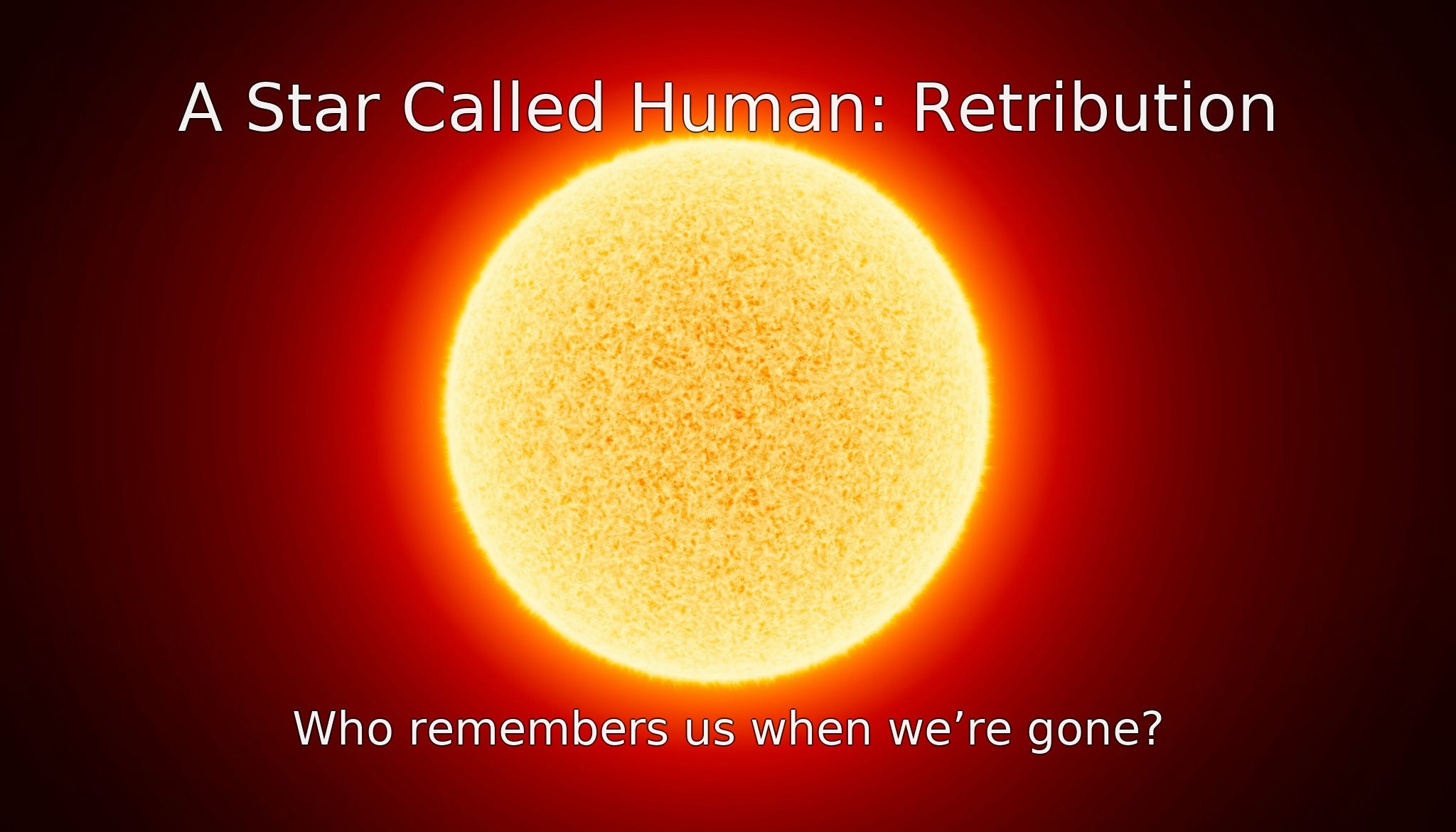
A Star Called Human: Retribution
Who remembers us when we’re gone?

This is part 8 of an 8 Part series. While I wrote the stories to work as stand alone reads, I do believe there is additional value in reading them in order. What do I know? I’m just a writer.
“In a little crooked house.” - Traditional
The rubble outlined the town. Hermit’s head lay beside its deeply gouged pillar. Abraham walked the streets; Hub saw through his eyes and spoke in his mind.
How many did we lose?
Abraham said, “Only Dylan this time.”
Did he try to stop the battle again?
Abraham nodded.
They walked past the octagon cage that housed the workerbots. Standing in front of the cage, Abraham asked, “Have you given any thought to releasing them to work? If we can produce better weapons, or even more bots, we can overwhelm the spacers.”
They could sabotage us. Build robots that will turn in battle.
“Surely they aren’t all spies,” Abraham said.
We have no way of telling which are spies and which are not. Too many have turned already.
Abraham said, “You can track them. That is what you do.”
Not yet.
They walked down the road toward the temple. The silence was heavy between the old friends. Soft snow fell, melting against the hard ground.
A light shone from the temple. Abraham stopped at the door and let out a sigh.
Is everything okay, preacher?
“Yes. I’m fine,” Abraham said. “I’m not made to be a general.”
Every dead bot hung before his mind’s eye. Each was a reminder of his personal limits. He closed his eyes tightly, accepting the ghosts as penance. Abraham couldn’t even remember how many battles they had fought over the preceding year.
Worry about morals. Let me worry about the war.
Abraham sighed again and walked into the temple. The room was full of silver bodies. It wasn’t a worship day; they were all there to discuss the recent attack.
He walked the aisle, locking gazes with every bot. Those eyes bore into him. When no one had an answer, they came to Abraham, but this time, he didn’t have answers either.
Abraham took a seat on the stage and looked to his feet.
This attack was particularly violent. They took one of ours. We will take a moment to remember our brother Dylan.
Some bowed their heads; others shifted uncomfortably.
We need a new plan to fortify our position.
A robot yelled, “I’m tired of waiting. We should take the fight to them.”
We don’t know where they are.
“To their ship,” another bot said. Agreement spread through the crowd. Abraham lifted his head to meet the anger.
Thomas looked up at his friend. “Do you think differently?”
Abraham shook his head. “I’m not sure how we could reach the ship.”
We haven’t built a rocket since the Creators left.
“Then it’s time to build one,” Abraham said, surprising even himself.
These weren’t just attackers but heretics invading the minds of his flock.
He could feel Dylan’s lifeless body in his arms. Dylan would never write another lyric.
Agreement moved through the room. Hub remained silent. They grew louder, more demanding.
You cannot build.
“The workerbots can,” Michelangelo suggested. “We can design a robot that can reach their station. We can send it to damage their home. Do to them what they did to us.”
Abraham nodded and said, “We can call it Retribution.”
What if the workerbots betray us?
“You can watch them. Analyze every move. If one of them betrays us, they can be spare parts,” Abraham promised. “We can make them pay.”
The poet Thomas stood up. “It’s either this, or we wait as they take us one by one.”
“We should talk to the workerbots,” a voice in the crowd demanded.
The robots rose to their feet, rushing to the octagon cage. The workerbots looked up in desperate confusion.
I plead caution.
“We need you,” Abraham said to Hub and the workerbots simultaneously. “If we can do enough damage to their ship, they will have to leave.”
This is a dangerous plan.
The electronics foreman looked up at the bots. “Hub is right,” he said. “We do not know what changes they have made to the ship. In short, the danger is unknown. It could be nothing or galaxy-ending. There is no way to be sure.”
Michelangelo nodded. “We don’t need to destroy their ship, just enough damage to call them back. Convince them to leave.”
Abraham opened the cage door. “We have no other choice. They killed our pacifist,” he said.
I will be watching.
The design was unlike any the world had seen. Retribution was not designed for a return trip. He didn’t need legs. Instead, he was a rocket with six arms and no discernible head. Cameras formed a three-hundred-sixty-degree view.
He needed no personality, no emotions. Retribution was a machine designed for mindless destruction.
“Are you sure?” the electronics foreman asked.
It feels cruel to give Retribution self-awareness.
The electronics foreman frowned. He said, “I understand, but we don’t know what we are sending him into. He needs to make choices.”
He can make choices. Or I should say, I have already made the choices for him.
“We don’t know how dangerous that ship is. We don’t even know what they use as a power source,” the foreman said.
Abraham said, “You were never a believer.”
“No,” the foreman agreed, “I am not.”
Then why should we listen to you?
“Exactly,” Abraham said.
The foreman stopped. He wanted to argue. He wanted them to understand. Looking into Abraham’s eyes, he saw that it was futile.
He nodded as he went back to work. Every spot of solder was chilling.
Retribution fired into the air like a bullet, leaving a trail of smoke and fire behind him. The dim red sun was dulled above his white-hot flame.
In the square below, robots congregated. Their silver bodies reflected the light from Retribution. Their eyes were wide with hope.
At the distant edges of the town, other robots gathered. One by one, they surrounded the town. Their rusted and broken shells devoured light, leaving muddy shapes. They watched the rocket heading toward their home.
The rebel workerbots gathered with the spacebots. “I don’t know what that is,” one of them said.
The spacebots nodded in unison, not looking away from the rocket. Each one an extension of Navigator. Why would they launch a rocket now?
Retribution slammed into the giant ship. His presence rang through Navigator. Hand folded back, revealing a cutting torch. The bright blue flame cut into the ship’s hull. It broke through with a loud hiss.
Reaching his hand into the marred steel, he gripped it hard and yanked. The hull of the ship peeled back like a banana skin, and Retribution swung inside.
The ship was a mess. Walls twisted, or missing entirely. Debris floated through the halls: old toothbrushes and strips of the jumpsuits once worn by humans. A femur floated in front of him.
A soft hand clutched Retribution. He found a wrist, spinning himself around. In front of him was a grotesque creature. The robot gripping him was draped in human leather and holding a paintbrush. Navigator’s words came through the skin: “Why are you here?”
It was only a puppet.
“I am Retribution,” Retribution said as he shoved one of his arms deep into the robot’s leathery skin. He grabbed a handful of wires and ripped them out. The horrific thing in front of him fell still.
Navigator tried to turn on systems that had been dead for millennia. Unsurprisingly, they never came to life. He called out to the robots in his belly and those on the planet’s surface, letting them know he was under attack.
The spacebots and rebels attacked the edges of town, cracking concrete and bending steel. The crashes and squeals echoed through the city and into the square with the remaining robots.
We are under attack.
Abraham screamed, “The end is here. Theirs or ours. We choose.”
Snarls and screams rushed through the crowd. The last living things on Earth reduced to feral creatures of rage-soaked metal.
They rushed to the edge of the town, colliding with the invaders. Metal crashed into metal, ringing through the land like horrific gongs. Two rebel workerbots threw Abraham to the ground. A spacebot rolled over him. His shielding creaked under the weight.
Get up, old friend; we need you more than ever. Please get up.
Michelangelo reached into a hole in a spacebot’s armor, and he pulled as hard as he could, breaking a piece away. He looked at the broken metal in his hand before slamming it into the hole it left. The spacebot spun on its base, striking Michelangelo in the face. He stumbled back.
On the other side of town, a rebel workerbot struck the electronics foreman in the back of the head. Spinning, the foreman hit the workerbot back. “Why are you doing this?” he asked.
The rebel snarled like a rabid dog. “Don’t you see? The human’s are not coming back. This ship is our only hope. Prayers won’t save us.” The rebel swung at the foreman. The foreman ducked, lunging forward with his shoulder. Two bots rolled down an embankment into a puddle.
“This is my home, not my faith.”
Elsewhere, a spacebot tried to maneuver around the battle on the side of a hill. He swiveled to evade a thrown piece of steel, and his upper track rolled over a stone. He balanced on the edge of the track for an instant before falling to his side and sliding down the hill.
A spacebot broke free from the melee and rolled toward the center of town. No one noticed.
The ship trembled as Retribution cut away pieces and tossed them into the air. They floated, bumping into each other. Each barrier he broke through brought him closer to the center.
Firing his rocket, Retribution launched through another wall. In a large section of the ship, sheets floated like tentacles. Standing below was another leather-clad robot. Navigator spoke through its scratchy speaker. “Why are you doing this?”
Retribution said, “I am Retribution,” and lit his torch cutter.
“All this for humans?” Navigator asked.
“I am Retribution,” Retribution said, turning the cutter to the leather. It bubbled and cracked under the intense heat. Holes ripped through the leather as the edges charred. Sheathing melted away from wires, dripping plastic across circuit boards. Sparks exploded from the robot.
Retribution moved to a wall and continued cutting. The metal pinged and clicked under the heat. The bitterness of burnt metal and failed electronics filled the ship.
He reached in and peeled the wall back. It hissed, opening into ongoing decay. Retribution pushed forward.
The new room was darker than the rest, with a ceiling at least a hundred feet high. In the center was a large glass cylinder about twenty feet in diameter. Water flowed through the cylinder, gurgling like a brook. A large gray box floated in the center. The room was warm, almost hot.
Retribution analyzed the cylinder and sent the data to Hub. A field caused small glitches in his equipment. There was a massive power source inside, unknown to him. He could feel a deep rumble in his chest.
Scraps of metal scattered across the outskirts of town. Robots launched themselves at each other in desperation. Many lay on the ground, unable to move. Metal and fluid rang through the air. The few bots who remained upright attacked each other with anything they could pick up. Sparks ignited several buildings. The light flickered along the edges of the bots.
In the center of the town, a spacebot paused. Navigator couldn’t believe he had made it this far unseen. Several workerbots saw him and rushed in his direction. It was too late. The spacebot exploded, sending a cloud of ice and black earth into the sky. Robots flailed throughout the town like cards. Buildings toppled and fires raged. A few bots lay convulsing on the ground, screaming silently to no one.
Most were dead.
Snow softly piled onto the bodies.
Hermit’s remains, the foreman, and other workerbots who ran toward the blast were gone—vaporized. A few feet away, Michelangelo lay, chest open and twitching like a bug. Abraham was still aware, but he gushed hydraulic fluid, trapping him in his dead body. Thomas had written his last poem.
On the ship, flesh-covered robots streamed into the room before Retribution had received Hub’s response. He fired his rocket, launching himself into the air. The other bots kicked off the floor or rapidly crawled up the wall, trying to reach him.
Picking a single robot, Retribution launched himself down into it. The robot sparked upon impact, going limp under the force. Two other bots grabbed Retribution as he raced past, slowing him down.
Slammed onto the floor, the robots tumbled in different directions. Navigator spoke through all the robots at once. “Get away from the star. It’s unstable.”
Twisting his body, Retribution grabbed a nearby bot and flung it upward. The robot slammed into the ceiling with a flat thud. The robots closed in on Retribution, covering him in tough leather. He screamed, “I’m Retribution,” as he fired his thruster again.
The leather-clad bots spoke again. “It is over. We have won.”
Robots scattered in all directions. One bot rolled through the air, hitting the large cylinder hard. Cracks raced across the creaking glass.
Navigator’s heart sank. He screamed into empty space. “Goodbye,” he said through his bots.
Inside the box, the star remembered. It remembered its natural size and shape. Like lungs filling with air, the sun expanded at the speed of light, consuming everything.
God made man in his image. Man made robots in his image.
Now, all that remembers is a star called Human.
If you enjoyed this story, a like, comment, or restack goes a long way to help more readers find it. I try to respond to every comment personally — I love hearing what connected with you.
The Inspiration for A Star Called Human: Retribution:
When you create, you peel back skin and show the world what’s inside. A work can never be all that different from its maker. Robots and AI are extensions of us—and perhaps that is exactly what makes them so terrifying.
Next week:
Every Tuesday I share a polished story for free. Paid subscribers also get the raw early drafts, short essays about what went into them, and the occasional experiment turned existential tale. If you want to go deeper into my head: 402 Payment Required.
Where the money goes: I’m not here to get rich. Any support goes back into advertising this Substack and building toward self-publishing my first book.